
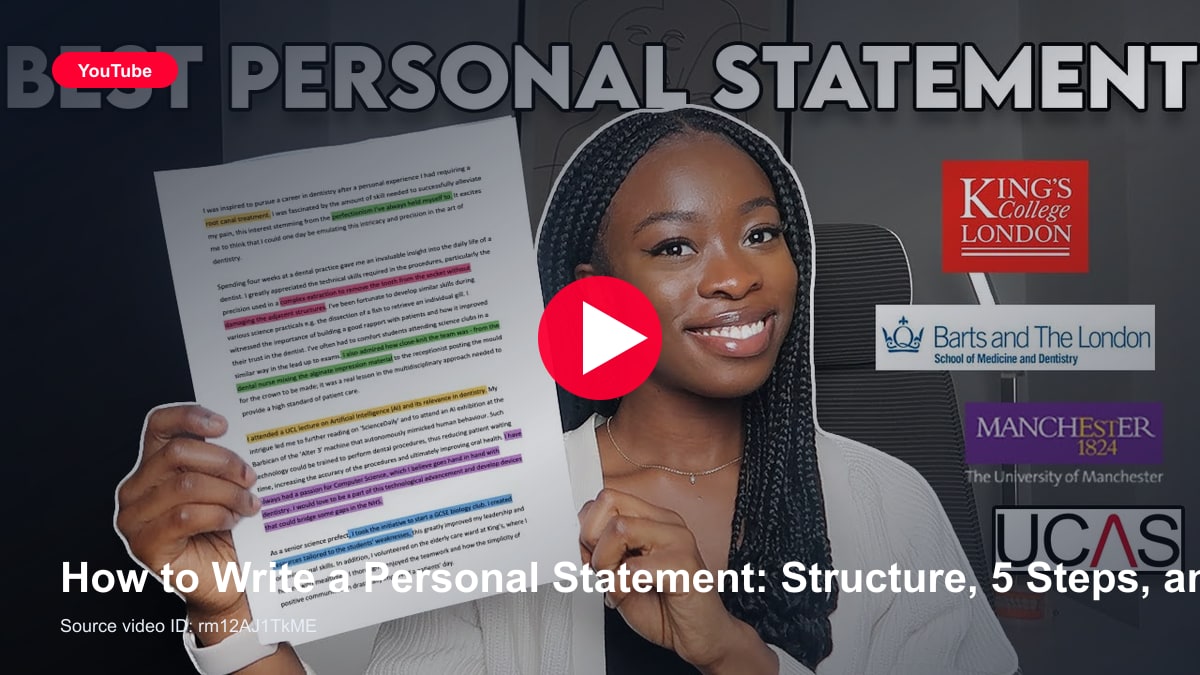
A personal statement is a written document that presents a candidate’s qualifications, experiences, and goals to an admissions committee or employer. According to UCAS, it is an applicant’s opportunity to communicate unique talents and experiences outside of grades and transcripts. Most personal statements run 500 to 1,000 words, though university-specific guidelines take precedence over general length rules.
What Is a Personal Statement?
A personal statement is a first-person narrative document submitted as part of a university, scholarship, or job application. It answers 3 core questions. These are who the applicant is, what qualifies them for the opportunity, and why the specific program or role fits their goals.
A personal statement must demonstrate to the admissions committee that the applicant has considered the program seriously. It summarizes academic and research experiences and communicates how those experiences are relevant to the degree being pursued.
What Are the 3 Types of Personal Statements?
There are 3 types of personal statements. These are university admission personal statements, graduate school personal statements, and job application personal statements.
| Type | Purpose | Typical Length | |—|—|—| | University admission | Secures undergraduate placement | 500 to 650 words (Common App) or 4,000 characters (UCAS) | | Graduate school | Demonstrates research readiness and program fit | 500 to 1,000 words | | Job application | Replaces or supplements a cover letter | 150 to 300 words |
How Long Is a Personal Statement?
A personal statement is 500 to 1,000 words for most graduate and university applications. UCAS personal statements for 2026 entry have a 4,000-character limit split across 3 structured questions. Each answer has a minimum character count of 350 characters and an overall character counter. The 3 questions cover formal education and skills, extracurricular activities and experiences, and future plans and program fit.
Job application personal statements are shorter. They run 150 to 300 words and function as an introductory pitch attached to a CV.
What Is the Structure of a Personal Statement?
A personal statement has 5 sections. These are the hook, the background and motivation, the evidence section, the program fit section, and the conclusion.
A compelling personal statement needs both structure and purpose. Each section connects experiences and goals to the opportunity at hand.
What Are the 5 Sections of a Personal Statement?
| Section | Purpose | Length | |—|—|—| | Hook | Captures attention and sets the tone | 1 to 2 sentences | | Background and motivation | Explains the origin of the applicant’s interest | 1 paragraph | | Evidence of qualifications | Demonstrates skills through specific examples | 2 to 3 paragraphs | | Program or role fit | Connects the applicant to the specific opportunity | 1 paragraph | | Conclusion | Restates commitment and closes with a forward-looking statement | 1 paragraph |
How Do You Write a Personal Statement in 5 Steps?
Writing a personal statement requires 5 steps. These are identifying the core message, drafting the hook, building the evidence section, writing the fit paragraph, and editing for clarity.
How Do You Start a Personal Statement?
Start a personal statement with a specific, vivid hook that introduces the central theme. Start with a powerful anecdote, surprising fact, or vivid description of a defining moment. Clearly introduce your theme or motivation: what brought you to this field or opportunity.
3 approaches work for opening hooks:
- A specific moment: “At 14, I rebuilt a broken radio from spare parts. That afternoon determined the next decade of my life.”
- A fact that reframes the topic: “Over 400 million people lack access to clean drinking water. I decided at 19 that I wanted to change that number.”
- A direct statement of purpose: “I am applying to study biochemistry because 3 years of undergraduate research in protein folding have shown me that the questions I want to answer live at the intersection of chemistry and medicine.”
Stay away from often-repeated or tired statements. A medical school applicant who writes that they are good at science and want to help people is not expressing an original thought.
How Do You Write the Background and Motivation Section?
Write the background section by explaining the specific experience, course, or event that sparked the applicant’s interest in the field. Share a specific event, class, or experience that ignited the passion. Highlight challenges or turning points that shaped perspective or commitment. Demonstrate self-awareness by reflecting on what those experiences taught the applicant.
Use concrete detail. “A biochemistry course in my sophomore year changed how I understood human health” is stronger than “I have always been interested in science.”
How Do You Write the Evidence Section of a Personal Statement?
Write the evidence section by demonstrating qualifications through specific, named examples from internships, research, leadership roles, or awards. Instead of saying “I am a leader,” describe a time when you led a project that had clear success. Use specific examples from internships, awards, research, or training to support your points.
Detail your interest and experience in your particular field and use the language professionals use in conveying this information. Refer to experiences such as work, research, classes, and conversations with people in the field.
Structure the evidence section using 3 checkpoints:
- Name the experience: internship, project, publication, or award
- State the outcome or skill gained: what changed because of that experience
- Connect it forward: how it prepares the applicant for the program or role
How Do You Write the Program Fit Section?
Write the program fit section by identifying specific aspects of the program or employer that align with the applicant’s goals. Identify several faculty members whose research aligns with your interests, explain why their research is relevant, and share how you might benefit from working with them.
A strong statement connects who the applicant is with what a university values. A line about a specific course, professor, or initiative shows thoughtfulness and depth. Connect the dots between the applicant and the institution and be specific. Generalities are to be avoided.
How Do You Write a Personal Statement Conclusion?
Write the conclusion by restating the applicant’s commitment and connecting their goals to the opportunity. The conclusion should tie everything together and leave the reader with a final impression of commitment and potential. Restate your interest and end with a strong closing statement that makes it clear why you are an ideal candidate. Do not introduce new information in the conclusion.
What Are 2 Personal Statement Samples?
Sample 1: Graduate School Personal Statement
> The turning point in my academic career came during a 2022 fieldwork placement in Lagos, where I documented informal land tenure disputes across 6 urban settlements. I entered the placement as a researcher. I left it as someone who understood that data without policy application has no consequence. > > I hold a first-class degree in Urban Planning from the University of Ibadan, where I graduated 2nd in a cohort of 87. My undergraduate dissertation, which examined the effect of satellite imagery on land dispute resolution in peri-urban communities, was nominated for the Faculty of Environmental Sciences prize in 2023. > > The MSc in Spatial Planning at University College London directly addresses the gap I identified during my fieldwork: the absence of a formal bridge between geospatial data collection and municipal policy reform. Professor Sarah Millington’s research on participatory mapping in West African cities aligns precisely with my postgraduate research interest. I intend to build on her 2021 paper on community-led land titling as the foundation of my dissertation. > > I am prepared to contribute to UCL’s research community and to apply what I learn directly to planning reform at the local government level in Nigeria.
Sample 2: Job Application Personal Statement
> I am a data analyst with 4 years of experience in financial services, specializing in risk modelling and client reporting. At FirstBank Nigeria, I reduced monthly reporting cycles from 12 days to 5 days by automating 3 manual processes using Python and SQL. I hold a professional certification in Data Analysis from Google and a degree in Statistics from the University of Lagos. I am applying for the Senior Analyst role at Stanbic IBTC because your team’s focus on real-time market analytics matches the direction I have pursued in the last 2 years. I bring both the technical capability and the sector experience your role requires.
What Are the Most Common Personal Statement Mistakes?
There are 5 common mistakes in personal statements. These are writing a generic opening, listing achievements without context, ignoring the specific program, exceeding the word limit, and submitting without a third-party review.
- Generic opening: Starting with “From a young age, I have always been passionate about…” is the most common and weakest opening in admissions writing. Replace it with a specific moment.
- Listing without context: A list of achievements with no reflection tells the reader what happened, not what it means. Connect every achievement to a skill or insight.
- Ignoring the specific program: The personal statement must demonstrate that the applicant has considered the specific program seriously. It is the opportunity to explain why a given program is the right one.
- Exceeding the word limit: Ignoring stated word or character limits signals poor attention to detail. Admissions officers apply this as a negative signal.
- Skipping the review stage: Show the statement to a third person before submission. A new reader catches mistakes the writer misses during proofreading.
For another writing guide, see How to Write a Book Review: Format, 5 Steps, and 1 Sample.
